(01) The Foundation

Who we are, and the oath that holds us to it.

The institution behind the work: what it is, what it promises, and who answers for it.

Mosticare Foundation

We exist to rid the world of mosquito-borne disease.

The independent global foundation for mosquito diseases and vector control, through honest information, real-time surveillance, and a promise to never poison the nature we defend.
Scroll · or move sideways
The Journal

Fresh from the field

New research, outbreak dispatches, and field notes, published continuously.

American Journal of Tropical Medicine and Hygiene + International Journal of Infectious Diseases just published the two-pillar South Asian WNV + chikungunya geographic-expansion institutional peg: Bangladesh now has documented autochthonous human WNV transmission and a sustained-circulation ECSA chikungunya lineage

Maria et al. Am J Trop Med Hyg documented the first probable human West Nile virus infections in Bangladesh, with 7 of 300 Japanese-encephalitis- negative acute encephalitis sera testing IgM-positive at 2.3 percent and two of the seven dying. Islam and Hasan IJID mapped seventeen years of CHIKV genomic evolution in Bangladesh and confirmed sustained local circulation of the Indian Ocean Lineage of the ECSA genotype, with a common ancestor around mid-2007 and sharp population growth in 2017. Together with the Lancet Regional Health Americas South American chikungunya resurgence editorial and the Emerg Infect Dis Bolivia 2025 first detection paper, the four-pillar 2026 global arboviral geographic-expansion editorial frame is now institutionally complete. The autochthonous-transmission window for South Asia is structurally closing across the multi-year horizon.

West Nile virus is becoming endemic in Europe, two new 2026 studies show

A systematic review of 27 studies and the first nationwide survey of 44,490 French blood donors together show West Nile virus is shifting from sporadic outbreaks to an established European presence. Integrated surveillance and blood-donor screening are emerging as the front-line response to a climate-driven spread.

ECDC has published its first monthly West Nile virus report. The cadence shift is the real story.

On 1 July 2026 the European Centre for Disease Prevention and Control published its first monthly West Nile virus surveillance product. Humans and animals now sit on a single dashboard, the report runs alongside the existing weekly, and the publication date lands on Q2 close. Two countries, three cases and three areas have held the weekly tally since W25. The case count is small. The cadence change is the real story.

Europe's third invasive Aedes just got a global data compendium: what Aedes japonicus, the Asian bush mosquito, means for the 2026 European summer alongside Aedes albopictus and Aedes koreicus

While Italy rolls out X-ray SIT and sterile-male trials to control Aedes albopictus, and Aedes koreicus expands across northern Italy, a third invasive Aedes, the Asian bush mosquito Aedes japonicus, has been quietly establishing itself across Belgium, the Netherlands, Germany, Switzerland, Austria, Luxembourg and northern France since the 2000s. The first global compendium on it was published last week.

West Nile Virus in Southern and Southeast Europe: an evergreen explainer on the Culex dusk-biting pattern, household risk windows, and why a bedroom mosquito net is still the most reliable chemical-free protection

West Nile virus (WNV) is the mosquito-borne disease that asks the narrowest question of a household in Italy, Greece, Romania, Bulgaria or Croatia between July and September: can a Culex mosquito reach the bedroom between dusk and dawn. The protection answer is structural (a net over the bed, a screen on the window, source reduction around the house), not pharmaceutical.

Canopy beds are back, and this time the bedroom trend is also the night-time mosquito answer

The interior design press in France, Germany, the Netherlands and Italy has been running pieces on the canopy bed as the 2026 bedroom trend, and the textile object the trend keeps returning to is the untreated canopy net over a dressed European bed. That same net, hung from a single ceiling point and falling in linen drape to mattress height, is the structural night-time answer to a sleeping adult and a mosquito population in the same room. The design object is the protection; the trend is the doorway.

The category we repudiate

Someone has to be blunt about snake oil. It is us.

The mosquito-protection aisle is full of products that range from ineffective to actively harmful, sold as if they were adequate protection. The public has a right to know the difference, and a right to a credible alternative.

Read the evidence
Sold as protection
Gas-emitting coils Indoor-air harm
Pyrethroid smoke devices

Burning one coil indoors emits fine particulate (PM2.5) on the order of dozens of cigarettes. The clearest case of a product that harms the air you breathe.

Liu et al. 2003 · Environ. Health Perspect.
Plug-in diffusers Unquantified exposure
Prallethrin vaporisers

A volatile insecticide released continuously into sealed rooms. Prallethrin is an EU candidate for substitution, and cumulative human exposure is poorly characterised.

Reg. (EU) 2024/2576 · prallethrin PT18
Scented candles Marginal efficacy
Citronella and essential-oil blends

A marginal repellent effect at close laboratory distances, and no meaningful protection in real outdoor conditions. Ambience sold as protection.

Fradin & Day 2002 · NEJM
Aerosol repellents Effective, not a barrier
DEET and picaridin

These work: DEET and picaridin are effective repellents. But they are a supplement, not a barrier. Skin and airway exposure, residue on clothing and bedding, and protection that ends the moment you forget to reapply.

Fradin & Day 2002 · NEJM
Uncertified marketplace nets No certification
Generic listings on Temu, AliExpress, Wish, unbranded Amazon

The purest illusion of protection: mesh often too coarse for the tiger mosquito, no EU BPR authorisation, no durability rating, sometimes claiming a treatment they do not carry. The appearance of protection over an open door.

No EU BPR authorisation · no durability rating
Mosticare LLINs
Physical barrier
No inhalation. No skin residue.

A textile mesh between human and vector. The mode of action that medicine keeps returning to.

Fabric-bound treatment
One active ingredient: permethrin

A single WHO-recommended active, permethrin, bound into the fibre, one formula not two. EU BPR authorised (permethrin, EU-0026815-0000). No leaching into air, water, or skin over the product lifetime.

Built to WHO standards
Category: long-lasting insecticidal net

Independent efficacy and safety testing against WHO target entomological endpoints. Traceable by batch.

Years, not hours
A net outlasts every spray

Aerosols wear off in hours and depend on you reapplying them. A long-lasting impregnated net keeps working for years, every Mosticare net for a minimum of three.

Measured limitation
Not a substitute for environmental control

A net protects a bed, a balcony, a garden enclosure. It does not drain a breeding site. We say so because it is true.

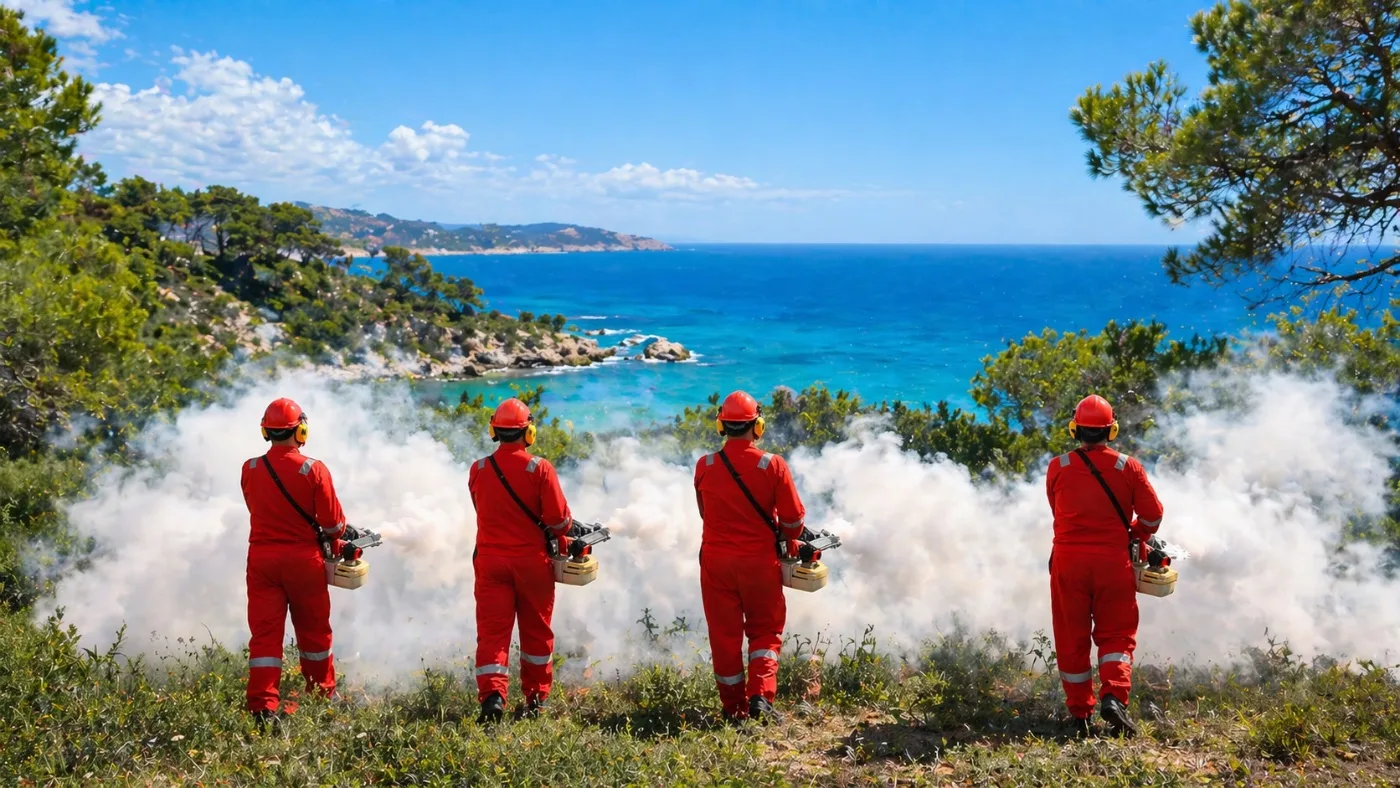
Pest-control workers in red coveralls releasing thick clouds of insecticide fog from backpack sprayers along a Mediterranean cliffside.
Field note
Mainland France's largest fogging operation
Antibes, French Riviera · September 2025
Spraying the Mediterranean with insecticide is not a strategy. It is an admission of failure.Protection is a barrier, not a toxic fog.

Mosquitoes are the basis of the food chain, we need them.

Primum non nocere
The environment counts as a patient.

We measure success by what does not happen. The bite that never lands, the fever that never arrives, the forest that is never poisoned to protect the people who live in it.

(03) Impact

The numbers we exist to lower.

700K+

Deaths a year from vector-borne disease worldwide (WHO).

2.9B

Insecticidal nets distributed globally to date (WHO).

3

Continents under active Mosticare surveillance.

0

Tolerance for harm to the ecosystems we defend.

Making our homes safe without destroying theirs.

The Mosticare Podcast

The first podcast in the world only about mosquitoes.

Every week, we explain why mosquitoes are a necessary piece of Nature to protect, while giving you travel hacks on how to avoid them to the maximum. Find them here:

Tune in every Sunday
Donate
(01) The Foundation

Who we are, and the oath that holds us to it.

The institution behind the work: what it is, what it promises, and who answers for it.

Mosticare Foundation

We exist to rid the world of mosquito-borne disease.

The independent global foundation for mosquito diseases and vector control, through honest information, real-time surveillance, and a promise to never poison the nature we defend.

Scroll · or move sideways
The Journal

Fresh from the field

New research, outbreak dispatches, and field notes, published continuously.

American Journal of Tropical Medicine and Hygiene + International Journal of Infectious Diseases just published the two-pillar South Asian WNV + chikungunya geographic-expansion institutional peg: Bangladesh now has documented autochthonous human WNV transmission and a sustained-circulation ECSA chikungunya lineage

Maria et al. Am J Trop Med Hyg documented the first probable human West Nile virus infections in Bangladesh, with 7 of 300 Japanese-encephalitis- negative acute encephalitis sera testing IgM-positive at 2.3 percent and two of the seven dying. Islam and Hasan IJID mapped seventeen years of CHIKV genomic evolution in Bangladesh and confirmed sustained local circulation of the Indian Ocean Lineage of the ECSA genotype, with a common ancestor around mid-2007 and sharp population growth in 2017. Together with the Lancet Regional Health Americas South American chikungunya resurgence editorial and the Emerg Infect Dis Bolivia 2025 first detection paper, the four-pillar 2026 global arboviral geographic-expansion editorial frame is now institutionally complete. The autochthonous-transmission window for South Asia is structurally closing across the multi-year horizon.

West Nile virus is becoming endemic in Europe, two new 2026 studies show

A systematic review of 27 studies and the first nationwide survey of 44,490 French blood donors together show West Nile virus is shifting from sporadic outbreaks to an established European presence. Integrated surveillance and blood-donor screening are emerging as the front-line response to a climate-driven spread.

ECDC has published its first monthly West Nile virus report. The cadence shift is the real story.

On 1 July 2026 the European Centre for Disease Prevention and Control published its first monthly West Nile virus surveillance product. Humans and animals now sit on a single dashboard, the report runs alongside the existing weekly, and the publication date lands on Q2 close. Two countries, three cases and three areas have held the weekly tally since W25. The case count is small. The cadence change is the real story.

Europe's third invasive Aedes just got a global data compendium: what Aedes japonicus, the Asian bush mosquito, means for the 2026 European summer alongside Aedes albopictus and Aedes koreicus

While Italy rolls out X-ray SIT and sterile-male trials to control Aedes albopictus, and Aedes koreicus expands across northern Italy, a third invasive Aedes, the Asian bush mosquito Aedes japonicus, has been quietly establishing itself across Belgium, the Netherlands, Germany, Switzerland, Austria, Luxembourg and northern France since the 2000s. The first global compendium on it was published last week.

West Nile Virus in Southern and Southeast Europe: an evergreen explainer on the Culex dusk-biting pattern, household risk windows, and why a bedroom mosquito net is still the most reliable chemical-free protection

West Nile virus (WNV) is the mosquito-borne disease that asks the narrowest question of a household in Italy, Greece, Romania, Bulgaria or Croatia between July and September: can a Culex mosquito reach the bedroom between dusk and dawn. The protection answer is structural (a net over the bed, a screen on the window, source reduction around the house), not pharmaceutical.

Canopy beds are back, and this time the bedroom trend is also the night-time mosquito answer

The interior design press in France, Germany, the Netherlands and Italy has been running pieces on the canopy bed as the 2026 bedroom trend, and the textile object the trend keeps returning to is the untreated canopy net over a dressed European bed. That same net, hung from a single ceiling point and falling in linen drape to mattress height, is the structural night-time answer to a sleeping adult and a mosquito population in the same room. The design object is the protection; the trend is the doorway.

Read full blog here
The category we repudiate

Someone has to be blunt about snake oil. It is us.

The mosquito-protection aisle is full of products that range from ineffective to actively harmful, sold as if they were adequate protection. The public has a right to know the difference, and a right to a credible alternative.

Read the evidence
Sold as protection
Gas-emitting coils Indoor-air harm
Pyrethroid smoke devices

Burning one coil indoors emits fine particulate (PM2.5) on the order of dozens of cigarettes. The clearest case of a product that harms the air you breathe.

Liu et al. 2003 · Environ. Health Perspect.
Plug-in diffusers Unquantified exposure
Prallethrin vaporisers

A volatile insecticide released continuously into sealed rooms. Prallethrin is an EU candidate for substitution, and cumulative human exposure is poorly characterised.

Reg. (EU) 2024/2576 · prallethrin PT18
Scented candles Marginal efficacy
Citronella and essential-oil blends

A marginal repellent effect at close laboratory distances, and no meaningful protection in real outdoor conditions. Ambience sold as protection.

Fradin & Day 2002 · NEJM
Aerosol repellents Effective, not a barrier
DEET and picaridin

These work: DEET and picaridin are effective repellents. But they are a supplement, not a barrier. Skin and airway exposure, residue on clothing and bedding, and protection that ends the moment you forget to reapply.

Fradin & Day 2002 · NEJM
Uncertified marketplace nets No certification
Generic listings on Temu, AliExpress, Wish, unbranded Amazon

The purest illusion of protection: mesh often too coarse for the tiger mosquito, no EU BPR authorisation, no durability rating, sometimes claiming a treatment they do not carry. The appearance of protection over an open door.

No EU BPR authorisation · no durability rating
Mosticare LLINs
Physical barrier
No inhalation. No skin residue.

A textile mesh between human and vector. The mode of action that medicine keeps returning to.

Fabric-bound treatment
One active ingredient: permethrin

A single WHO-recommended active, permethrin, bound into the fibre, one formula not two. EU BPR authorised (permethrin, EU-0026815-0000). No leaching into air, water, or skin over the product lifetime.

Built to WHO standards
Category: long-lasting insecticidal net

Independent efficacy and safety testing against WHO target entomological endpoints. Traceable by batch.

Years, not hours
A net outlasts every spray

Aerosols wear off in hours and depend on you reapplying them. A long-lasting impregnated net keeps working for years, every Mosticare net for a minimum of three.

Measured limitation
Not a substitute for environmental control

A net protects a bed, a balcony, a garden enclosure. It does not drain a breeding site. We say so because it is true.

Pest-control workers in red coveralls releasing thick clouds of insecticide fog from backpack sprayers along a Mediterranean cliffside.
Field note
Mainland France's largest fogging operation
Antibes, French Riviera · September 2025
Spraying the Mediterranean with insecticide is not a strategy. It is an admission of failure.Protection is a barrier, not a toxic fog.

Mosquitoes are the basis of the food chain, we need them.

Primum non nocere
The environment counts as a patient.

We measure success by what does not happen. The bite that never lands, the fever that never arrives, the forest that is never poisoned to protect the people who live in it.

(03) Impact

The numbers we exist to lower.

700K+

Deaths a year from vector-borne disease worldwide (WHO).

2.9B

Insecticidal nets distributed globally to date (WHO).

3

Continents under active Mosticare surveillance.

0

Tolerance for harm to the ecosystems we defend.

The Mosticare Podcast

The first podcast in the world only about mosquitoes.

Every week, we explain why mosquitoes are a necessary piece of Nature to protect, while giving you travel hacks on how to avoid them to the maximum. Find them here:

Tune in every Sunday